Our Daily Green

Wednesday, October 9, 2013

Mobile phones that give back to charity

Giv Mobile


Answer the call with GIV Mobile, wireless for a cause. GIV Mobile offers a large selection of phones to choose from or you can bring your own compatible GSM device. Pick either the $40 Unlimited Everything Plan or the $50 Unlimited Everything Plan, plus no contracts to tie you down! Your wireless service can do more than keep you connected, it can help save the world! Choose up to 3 charities and they will donate 8% of your monthly plan.

After you enter the giveaway make sure to stop by GIV Mobile to see how you can make a difference. Some of the charities include environmental non-profits such as The Conservation Fund, The Nature Conservancy, The Wilderness Society, or American Rivers. These pre-screened charities focus on preservation and protection of our natural resources. GIV also includes charities like the American Cancer Society and the Carnegie Institution for Science.

Giveaway

One reader will receive 3 Months of Unlimited Everything and a Nexus 4 from GIV Mobile 
{RV $450}. 
See form for Entry Details. Open to U.S. residents. You must be 18 years old to enter to win. 
Ends 10.23.13
All entries will be verified. An email address is required to enter. The winner will be chosen randomly through Giveaway Tools and contacted via email. A reply to the winning email is required within 48 hours before a new winner is chosen. One person entering per household please. U.S.residents only. This giveaway ends at 11:59 PM EST on Oct 23, 2013. 

  Disclosure: GIV Mobile is responsible for shipment of prize. 
Companies and bloggers, if you would like to participate in group giveaway events like this one, sign up to be emailed about future events hosted by The Review Wire.

Friday, October 4, 2013

Geothermal as renewable source of energy

While many environmentally conscious consumers are exploring new technologies, such as fuel cells and solar panels, to save energy, geothermal energy is literally as old as the earth. In fact, the word geothermal comes from the Greek words geo (earth) and therma (heat). Geothermal energy is heat from the earth.
photo courtesy of: Wikimedia Commons

Natural evidence of geothermal heat is present in volcanoes and hot springs. Ancient Romans, Chinese, and Native Americans utilized the geothermal heat from hot springs when the heated water flowed to the surface.

Traditionally, applications and use of the earth's heat has taken place near tectonic plates boundary zones, such as the Pacific "Ring of Fire" with an abundance of active volcanoes. Geothermal energy has been developed in Indonesia, The Philippines and several countries in Central America, as well as more industrialized nations including Japan, New Zealand, and Mexico. With today's more sophisticated technology, a consumer does not need to be located near a hot spring or tectonic plate to appreciate the benefits of geothermal energy.

According to the U.S. Environmental Protection Agency (EPA), “geothermal heat pumps are among the most efficient and comfortable heating and cooling technologies currently available…” In fact, some geothermal heat pumps can be over 45% more energy efficient than traditional options.

Geothermal heat pumps take advantage of the uniform temperatures beneath the surface of soil or water to heat or cool the home. A heat pump moves heat from outdoors to indoors. There are four types of geothermal heat pump systems, three closed loop options: horizontal, vertical, or a pond/lake system and one open-loop option. The best choice for residential applications would be dependent on climate, soil, available land, and local installation sites.

A geothermal system begins with buried pipes a few feet beneath the surface, where the temperature remains steady throughout the year. A heat pump operates on the basic principle of transferring heat. Rather than burning fuel such as oil or gas to create heat, a device moves the heat from one place to another, via the buried pipes and tubes, employing a refrigerant to direct the heat flow to the desired area. Heat naturally moves from a high temperature to a lower temperature. Heat pumps can either bring heat into or remove heat from a building, depending on how the flow is directed. The technology is very similar to the way refrigerator coils work, but on a smaller scale. To capture or disperse the heat from beneath the earth's surface, a larger system of coils and tubes is required, hence the need to first assess whether a geothermal system needs horizontal or vertical loops, as well as the open or closed system.

There are several Energy Star rated geothermal heat pumps on the market that qualify for a consumer energy efficiency tax credit. While ENERGY STAR products may initially cost more to purchase, between lowered energy bills and tax credits, the cost is often offset. Currently, several models qualify for a 30% rebate of cost, through December 31, 2016. The rebate applies to both existing homes and new construction.

Today's post has been brought to you by American Comfort Heating in Chicago.

Wednesday, October 2, 2013

Junking food is bad for everyone (reprint from OtherWords.org)


The food Americans waste could help end hunger in this nation.

Jill Richardson
Several years ago, I worked in a grocery store bakery. At the end of each day, we threw away piles of perfectly good food.
Before the store closed, employees walked down each aisle, checking the expiration dates of bread, bagels, and cookies to toss out whatever expired that day — whether the food was actually still good or not. Then we chucked all of the day’s fresh-baked pastries, muffins, and bread. And those were definitely still good to eat.
As employees, we weren’t allowed to take it home and eat it ourselves. The store worried that if we could, we’d start baking too much on purpose in order to secure a larger supply of excess food at the end of the day.
I found the waste offensive.
Sometimes I snuck a bit of it out with me at the end of the night to hand to homeless people. I could have been fired for that. The store feared the prospect of attracting a line of homeless people begging for free food. And what if someone ate expired food, got sick, and sued? The food had to go in the trash.
According to a new study, this kind of waste goes on even after the food goes home with customers. Americans trash 40 percent of the food we buy — $165 billion worth per year — often because the food is past the expiration date.
Richardson-Junk Food-Nick Saltmarsh
Nick Saltmarsh/Flickr
“Best before” and “sell by” dates can be arbitrary, concluded the researchers with the Harvard University Law School Food Law and Policy Clinic and Natural Resources Defense Council (NRDC) who conducted the study. We shouldn’t see them as indicative that food has spoiled. If a food looks rotten or smells bad, that’s when you know it’s time to toss it out — not just because a date on the package has passed.
“Food from the farm to our fork eats up 10 percent of the total U.S. energy budget, uses 50 percent of U.S. land, and swallows 80 percent of all freshwater consumed in the United States,” reads another NRDC report. Once in the landfill, wasted food yields methane, a greenhouse gas far worse than carbon dioxide.
But this wasted food doesn’t have to be a problem — it can also be a solution. At a time when 33 million Americans are “food-insecure,” and don’t get enough to eat, diverting just a fraction of perfectly good food from the landfill would feed all of them.
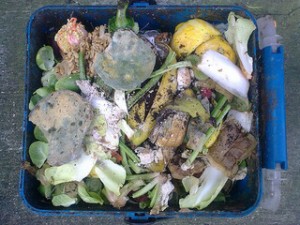
In my household, we also have a solution for the food that is no longer good for humans to eat. We feed it to our chickens and worms. We live in the city and keep a few hens for eggs. They are low-maintenance little pets who serve a number of purposes, like eating bugs and producing fertilizer. And they are ravenous for food scraps.
Whatever the chickens don’t take care of, we feed to the worms. We keep a worm compost bin, one that has holes large enough for airflow but small enough to keep rodents out. If the chickens won’t eat something, the worms certainly will. They turn rotting food scraps into black gold — worm compost — and we use it to grow strawberries, tomatoes, and salad greens. (Gardening also helps cut down on waste, since we can harvest highly perishable foods like lettuce as needed.)
What’s more, sometimes food past its prime is even salvageable as human food. Stale bread makes for great bread crumbs, overripe bananas become banana bread, and other types of overripe fruit are best for jams and pies.
Wasting 40 percent of our food while so many Americans go hungry is a national disgrace. As the Environmental Protection Agency puts it, we should “feed people, not landfills.”
OtherWords columnist Jill Richardson is the author of Recipe for America: Why Our Food System Is Broken and What We Can Do to Fix It. OtherWords.org

Creative CommonsExcept where otherwise noted, content on from OtherWords.org is licensed under a Creative Commons Attribution-No Derivative 3.0 License.